Showing posts with label asian stocks. Show all posts

Thursday, December 8, 2016

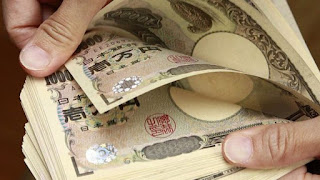
The Yen is slowly recovering. Overview for 08.12.2016

The USD/JPY pair is trading to the downside for the second day in a row, but not very actively, as the market is waiting for the outside signals.

While the demand for the American currency is rather calm, the Japanese Yen is slowly growing. The current quote for the instrument is 113.64. However, there are no any internal support factors.

According to the statistics published this morning, the country’s final GDP in the third quarter added 0.3% q/q, which is twice less than expectations of 0.6% q/q. On YoY, the indicator expanded by 1.3% after adding 2.2% in the second quarter. The market expected the number to be close to 2.3%.

Judging by the released data, one can think that the external uncertainty and the export decline have a significant effect on the Japanese GDP. Another negative factor is a slow salary growth over the country, which prevents retail sales from expanding.

On top of that, such indicator as the Foreign Bond Investment is improving very slowly. Partially, it is compensated by the growth of the Private Consumption in the third quarter (added 0.3% against expectations of 0.1%), but in the fourth quarter this indicator is very unlikely to provide any support because there is a limit to the consumer confidence.

The Yen responded to the statistics with an insignificant decline, but managed to process this news quite fast and was back to strengthening.

Wednesday, December 7, 2016

Wave Analysis 07.12.2016 (EUR/USD, GBP/USD, USD/JPY, AUD/USD)

EUR USD, “Euro vs US Dollar”

Probably, the EUR/USD pair completed the ascending impulse [c] in the flat 2. As a result, in the nearest future the market may resume falling and form the bearish impulse in the wave [i].


As we can see at the M30 chart, the wave (v) of [c] was truncated. On a shorter timeframe, the pair completed the bearish wave (i). Consequently, after finishing the local correction, the market may start falling in the wave (iii) of [i].


GBP USD, “Great Britain Pound vs US Dollar”

It looks like yesterday the GBP/USD pair completed the wave (y) in the double three [iv]. To confirm a new decline, the price has to form the bearish impulse in the wave (i).


As we can see at the H1 chart, the pair finished the diagonal triangle c of (y). On a shorter timeframe, the price is about to complete the wave i. It’s highly likely that on Wednesday the market may start a new local ascending correction.


USD JPY, “US Dollar vs Japanese Yen”

Possibly, the USD/JPY pair finished the long bullish impulse in the wave c of (y). In the nearest future, the market may start forming the descending impulse in the wave i or a.


As we can see at the H1 chart, after completing the diagonal triangle in the wave [5] of c, the pair finished the descending impulse in the wave (1). On Wednesday, the market may finish the wave (2) and then resume falling in the wave (3).


AUD USD, “Australian Dollar vs US Dollar”

Probably, the price completed the wave (ii). Earlier, the pair finished the descending impulse in the wave (i). It’s highly likely that in the nearest future the market may start a new decline in the wave (iii).


More detailed structure is shown on the H1chart. The pair finished the wave (ii) in the form of the zigzag with the triangle b inside it. To confirm a new decline, the market has to form the descending impulse in the wave i.

Tuesday, December 6, 2016

The Australian Dollar is retreating. Overview for 06.12.2016


The AUD/USD pair is trading downwards after another meeting of the RBA.

The Australian Dollar is being sold against the USD on Tuesday afternoon. The current quote for the instrument is 0.7444.

So, the December meeting of the RBA finished this morning. Just as expected, the rate remained unchanged at 1.5%. Right now, it’s too early to revise the indicator because the previous decrease hasn’t produced any observable effects so far. In its comments, the Australian regulator mentioned that it didn’t exclude a possibility of a particular slowdown in economic growth at the end of the year – but it’s just a pause before a new shoot forward. The real estate sector stabilized, or even improved in some aspects; in some cases, there might be seen a rise in housing prices, which is also positive. The labor market is still providing some mixed signals, but in the short-term, the employment is improving and this tendency may transform into a long-term one later.  

When it comes to the inflation in Australia, the RBA estimates it as very low at the moment and doesn’t expect it to increase. The current high exchange rate of the Aussie can make the transition period in the country’s economy more difficult.

Now, after the regulator’s new management mentioned the AUD and its influence on the country’s economy in its comments, we can say that the rhetoric of Mr. Stevens, ex-Governor of the RBA, is back. It appears that Mr. Lowe, the current Governor of the Australian Central Bank, reached the same point of the monetary policy stability as Stevens did in his time.

The neutral tone of the RBA’s comments put some more pressure on the Aussie. In the morning, large banks published their prediction relating to the country’s GDP, which indicated their expectations of a slowdown in economic growth.
 

Monday, December 5, 2016

Asian stocks climb on strong Dow close, US service report


HONG KONG (AP) — Asian stocks rose Tuesday following another record day on Wall Street as investor optimism bounced back quickly after the Italian referendum.
KEEPING SCORE: Japan's benchmark Nikkei 225 index climbed 0.5 percent to 18,360.54 and South Korea's Kospi jumped 1.4 percent to 1,990.53. Hong Kong's Hang Seng added 0.8 percent to 22,676.55 while the Shanghai Composite index edged 0.1 percent higher to 3,207.19. Australia's S&P/ASX 200 climbed 0.5 percent to 5,428.70. Benchmarks in Taiwan, Singapore, Thailand and Indonesia also advanced.
QUOTABLE QUOTE: "The markets appear to have come to the realization that the concerns paid to the Italian referendum may be too much or too early," said Jingyi Pan of IG Markets in Singapore. "Relief rally has become the favorite description for the overnight trend seen in both European and U.S. stock markets as traders tuned back to riskier assets."
SOUTH KOREAN RECKONING: Top business leaders were grilled by lawmakers over allegations that President Park Geun-hye allowed a corrupt confidante to pull government strings and extort companies. With Park facing possible impeachment, the Finance Ministry said it would "frontload" nearly 70 percent of government spending for 2017 to help boost the slowing economy. Shares jumped in response.
SERVICE SURVEY: Activity at U.S. services companies grew at its fastest pace last month in more than a year, according to a monthly survey of purchasing managers. The report, which found that production, hiring and new export orders all grew faster in November than the month before, is an encouraging sign for the broader U.S. economy, the world's largest.
WALL STREET: Major U.S. benchmarks pushed higher and the Dow Jones industrial average set another record high, rising 0.2 percent to 19,216.24. The Standard & Poor's 500 index climbed 0.6 percent to 2,204.71. The Nasdaq composite added 1 percent to 5,308.89. The U.S. rally erased any remaining pessimism following Italy's weekend referendum in which voters defeated proposed constitutional changes, triggering Premier Matteo Renzi's resignation. Investors are now looking ahead to the year's final market-moving event, next week's Fed meeting at which policymakers are expected to raise interest rates from ultralow levels.
ENERGY: The rally in oil prices petered out after four days of gains fueled by the OPEC deal to trim production. Benchmark U.S. crude futures lost 38 cents to $51.41 in electronic trading on the New York Mercantile Exchange. The contract rose 11 cents to $51.79 per barrel on Thursday. Brent crude, used to price international oils, shed 29 cents to $54.65 a barrel in London.
CURRENCIES: The dollar rose to 114.06 yen from 113.70 yen in Thursday's trading. The euro rose to $1.0751 from $1.0756.